Things I have learned:
1.) I learned that the Agricultural Revolution played an important role in starting the Industrial Revolution. Specifically, the enclosure system led to unemployment among farmers which forced them to go work in factories.
2.) I learned about the differences between socialism and communism. Socialism is an economic system that seeks to manage the economy through deliberate and collective social control. Communism is a blend of political and economic systems that seeks to manage both the economy and society by ensuring that property is owned collectively, striving for classlessness and statelessness.
3.) I learned about Marx's dialectical materialism. This was Marx's way of explaining why everything in history seems to happen in a certain way, specifically struggles between social classes.
Things that interested me:
1.) Britain was very strict with allowing people out of the country. I think the whole idea of keeping things secret was interesting. Since we live in the information age, it's hard to imagine a world where countries can keep things secret. Even North Korea can't hide that they are testing nuclear weapons.
2.) The Trans-Siberian Railway was, and still is, the longest railroad ever built. Seriously? That's pretty impressive considering it was built in 1916.
One question I still have:
With the introduction of the factory system, and all the mindless work forced upon the lower class citizens of society, did the Industrial Revolution cause more harm than good?
Sunday, February 13, 2011

Spotlight On: The Trans-Siberian Railway!
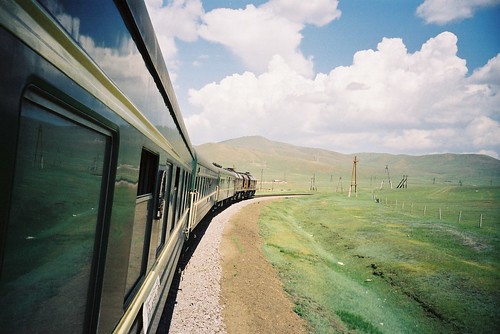
Many railroads were built during the Industrial Revolution, but none of them can stand up to the sheer magnitude of the Trans-Siberian Railway. Stretching just shy of ten thousand kilometers across the vast expanse of Russia from Moscow to the Pacific, the Trans-Siberian Railway is so much more than just a mode of transportation - it's a way of life! For those who travel on the train, Siberia is more than just a name, it's that last frontier- the new Texas.

In the late nineteenth century, the development of Siberia was hampered by poor transportation links within the region and between Siberia and the rest of Russia. The Great Siberian Route was just about the only road in the area suitable for wheeled transportation. Because rivers were covered with ice seven months out of the year, steamboats proved to be an ineffective option. During the cold parts of the year, cargo had to be carried on dog sleds. Only a railway could be a real solution to the region's transport problems. Full time construction of the Trans-Siberian Railway began in 1891 and was overseen by Sergei Witte, the current Finance Minister. Just like in the construction of the Transcontinental Railroad in America, Russian workers began building at both ends and worked toward the center. In 1916, the railway was completed, and to this day, it is the world's longest continuous railway. The Trans-Siberian Railway gave a positive boost to Siberian agriculture and also brought in millions of peasant-migrants from the western regions of Russia and Ukraine.


Interested? Then plan your trip today at TransSiberianRailway.org! "Once you have braved the snaking ticket queues (and met the sharp end of Russian customer service), on the Trans-Siberian you'll soon get to experience the real Russia that all the Cold War Propaganda you've been fed never prepared you for: multitudes of steely but twinkly-eyed and curious fellow Russian passengers all dressed in tracksuits and keen to get to know the foreigner who is passionate - or insane - enough to tackle their beloved Mother Russia from side-to-side by train.
You'll be regaled in broken English with tales of far-off sweethearts, and be offered all manner of Russian food and drink by some of the most truly generous people on Earth. Your liver may not thank you for the vodka, but the damage will be short-lived, unlike your memories of this fascinating journey - which will stay with you for a lifetime."Still not convinced? Maybe this video will persuade you...
US Event: Cumberland Road

The National Road, commonly called the Cumberland Road, was built by the United States' government in 1811 in response to the demand for a road tying the East to the West. President Jefferson appointed a board of commissioners to decide upon the exact route through which the extended road would run. Plans were made to construct the road from Cumberland, Maryland to Jefferson City, Missouri, but funding ran out and construction stopped at Vandalia, Illinois in 1838. The National Road project was a huge project for its time and it relates to the revolution in transportation that was going on in Britain at the time. This project, along with the construction of railroads, shows the focus that governments were putting on transportation, which became more and more important during the Industrial Revolution.
US Event: War of 1812

"The war has renewed and reinstated the national feelings and character which the Revolution had given, and which were daily lessened. The people . . . . are more American; they feel and act more as a nation; and I hope the permanency of the Union is thereby better secured." -Secretary of Treasury, Albert Gallatin 1816
The War of 1812 was a military conflict fought between the United States of America and the British Empire. America declared war for a number of reasons, including land disputes in the Northwest Territory and imprisonment of American merchants in the Royal Navy. Following defeats in Washington and Canada, the Americans repelled attacks on New York and ended up winning the war after the Battle of New Orleans. Victories at battles such as the Battle of New Orleans and the defense of Baltimore evoked a great national pride. The war ushered in an era known as the "Era of Good Feelings."
This was significant because the "Era of Good Feelings" allowed for industry to thrive in the United States. Industry was also boosted during the war effort. The War of 1812 also effected business relationships of entrepreneurs who worked on both continents, like Francis Cabot Lowell. Lowell modeled plans of British machines and built textile factories in America. He was instrumental in bringing the Industrial Revolution to the United States.
The War of 1812 is also significant for inspiring awesome works like Tchaikovsky's "1812 Overture."
People in the News: Thomas Malthus

"I think it will be found that experience, the true source and foundation of all knowledge, invariably confirms its truth." -Thomas Malthus
In his 1798 work, Essay on the Principle of Population, Malthus observed that plants and animals in nature tend to produce more offspring than can survive. He concluded that, if left unchecked, man could do the same thing. Malthus' view was that poverty and famine were natural outcomes of population growth that the food supply which was unable to keep up. Malthus observed the decline of living conditions in eighteenth and nineteenth, and he blamed it on three elements: excessive reproduction, inability of food supply to keep up with the population, and the irresponsibility of the lower classes. Malthus suggested the regulation of lower class family sizes, an idea very similar to the policy that China has implemented today.
Saturday, February 12, 2011
People in the News: James Watt

James Watt, a Scottish inventor and mechanical engineer, is know his work and improvements on in steam engine technology. Steam engines had already been invented and implemented in factories all over Britain by the time of Watt's birth in 1736. In 1764, Watt was given a Newcomen engine to repair. Realizing that it was hopelessly inefficient, Watt proposed a seperate steam condenser that would prevent the excessive loss of steam that occurred with most Newcomen engines. Watt patented this idea in 1769. Over his lifetime, Watt patented several other inventions including the rotary engine, the double-action engine and the steam indicator, which records the steam pressure inside the engine. Watt's contributions made factories much more efficient and more profitable, which boosted Britain's and all of Europe's economies.
Thursday, February 10, 2011
People in the News: Karl Marx

"Democracy is the road to socialism" -Karl Marx
Karl Marx was a German born philosopher and is arguably one of the most influential men in the world of politics. His work inspired revolutions and communist regimes throughout the twentieth century. Marxian socialism in the purest sense is communism. Marx's theories were centered around the idea that within societies, there are constant class struggles that impede the development of human productive power. Marx concluded that it is only natural for capitalist, democratic societies to move toward communism. He called this pattern dialectical materialism, modeled after George Hegel's thesis, antithesis, and synthesis. Marx's analysis of history and economics came together in a prediction of the breakdown of capitalism and a revolt by the working class, resolving in a classless "perfect society." Though Marx's theories have yet to be proven effective in the real world, he is still one of the most influential thinkers of the nineteenth century.
Introduction

While the revolutions in France were setting up Europe for the modern political world, the Industrial Revolution, which took its roots in Great Britain from 1750 to 1850, was beginning to transform economic and social life. The rise of modern industry had a profound impact on people and their lives, greatly modifying human experience. It changed patterns of work, attitudes toward child labor, social class structure, and eventually, balance of political power. With the growth of the factory system came the growth of a large class of laborers, who, as decades passed, moved closer and closer to radical social policies e.g. Marxian socialism.
By writing this blog, I hope to show the understanding and knowledge I have gained from this chapter, specifically the effects the Industrial Revolution has had on the modern world.
Essential Question: Why did the Industrial Revolution start in Great Britain and not somewhere else in Europe?

Subscribe to:
Posts (Atom)